
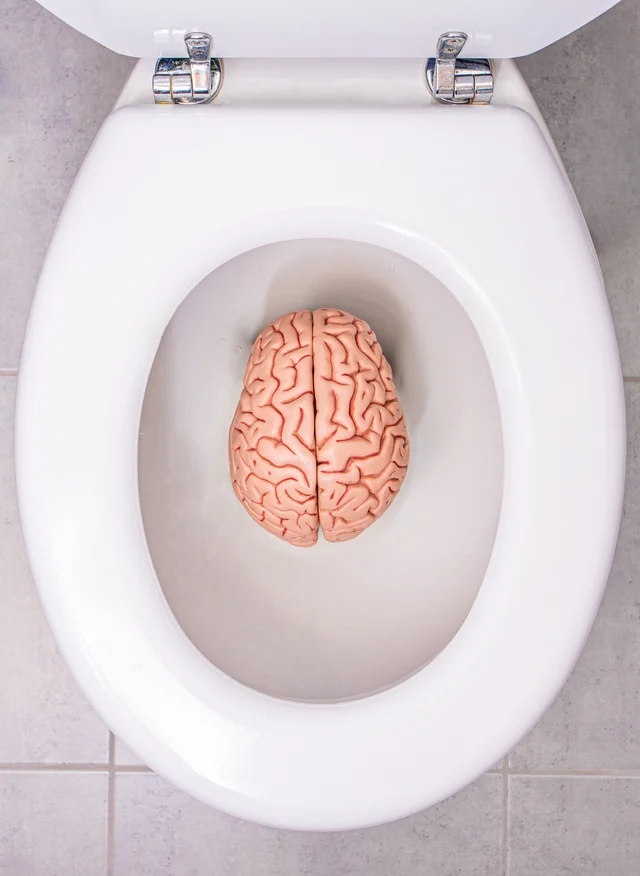
There are plenty of perimenopause symptoms that nobody warns you about.
The random rage.
The anxiety.
The insomnia.
The feeling that your body has suddenly decided to freelance without consulting you first.
But none of them frightened me quite as much as brain fog.
Before perimenopause, I prided myself on having a sharp memory.
I could remember phone numbers from years ago. Conversations from months earlier. Random facts that served absolutely no purpose other than proving my brain was still firing on all cylinders.
Then something changed.
At first it was small things.
Walking into rooms and forgetting why.
Losing my train of thought halfway through a sentence.
Calling things by completely the wrong name.
Forgetting what I was about to say before the words had even left my mouth.
Annoying, yes.
But then it became frightening.
I would be having a conversation and suddenly my mind would go blank.
Not distracted.
Not daydreaming.
Blank.

Like somebody had unplugged the power cable.
I knew the information was somewhere in my head, but I couldn’t reach it.
The harder I tried, the worse it became.
What made it even more terrifying was that nobody had properly explained what brain fog actually feels like.
People talk about forgetfulness.
They make jokes about losing their keys.
What they don’t tell you is that it can feel as though your intelligence has quietly packed its bags and left without warning.
You begin questioning everything.
Is this normal?
Am I getting dementia?
Is there something seriously wrong with me?
Will I be like this forever?
Then anxiety joins the party.
Because if there is one thing anxiety loves, it is uncertainty.
Now your brain isn’t just struggling to remember things.
It is desperately scanning for catastrophic explanations.
Brain tumour.
Early dementia.
Alzheimer’s.
Permanent cognitive decline.
You know the thoughts aren’t rational, but that doesn’t stop them arriving.
Day after day.
And that’s what makes brain fog so cruel.
It doesn’t just affect memory.
It attacks confidence.
You stop trusting yourself.
You hesitate before speaking.
You second-guess what you know.
You begin feeling embarrassed in situations that never used to bother you.
For me, that was perhaps the hardest part.
Not the forgetting.
The grieving.
The feeling that I had somehow lost a part of myself.
The woman who could effortlessly recall information now struggled to hold onto a thought for ten seconds.
The woman who could speak confidently sometimes found herself stumbling over words.
The woman who felt mentally sharp suddenly felt like she was wading through wet cement.
Nobody talks enough about that grief.
Because when your mind changes, it can feel as though your identity changes too.
If you’re experiencing this right now, I want you to know something.

You are not imagining it.
You are not being dramatic.
And you are certainly not alone.
Thousands of women are quietly experiencing exactly the same thing.
Many are terrified.
Many are confused.
Many are lying awake at night wondering if they will ever feel like themselves again.
I wish I could tell you exactly when it gets better.
I can’t.
I wish I could give you a guaranteed solution.
I can’t do that either.
But what I can tell you is that countless women report improvements once hormones stabilise, sleep improves, anxiety becomes more manageable, and they begin understanding what their body is actually going through.
Most importantly, brain fog does not mean you are stupid.
It does not mean you are failing.
And it does not mean you are disappearing.
Right now, your brain may feel like it is wrapped in fog.
But the person underneath that fog is still very much there.
The real story isn’t memory loss.
It’s the fear, grief, anxiety, and identity crisis that memory loss creates.
If perimenopause has changed the way you think, feel, or function, how much of the struggle comes from the symptoms themselves, and how much comes from grieving the person you used to be?
If you enjoyed this read check out another one from the Midlife Women Series Rare Menopause Symptoms Through an ADHD Lens